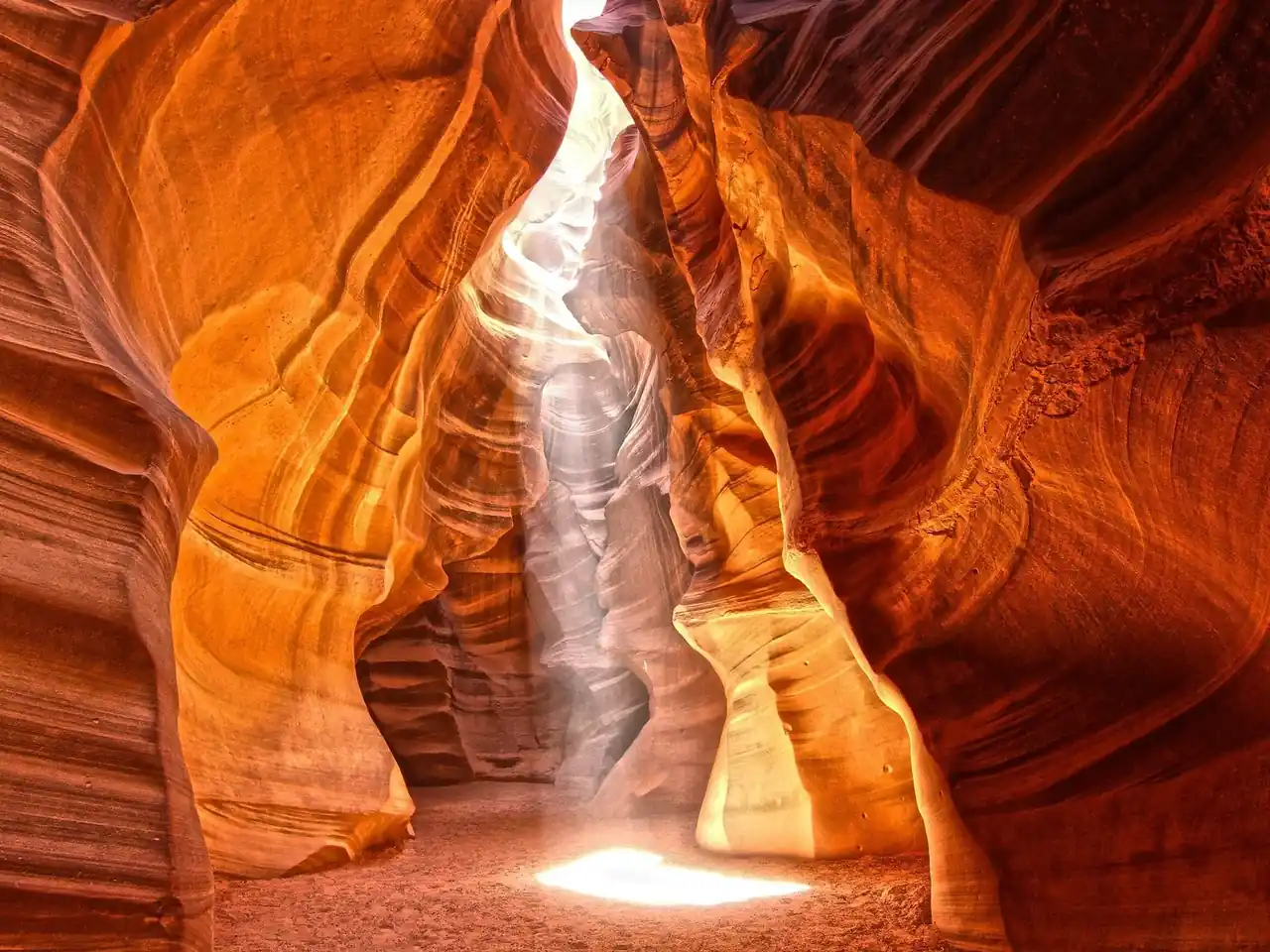
Upper Antelope Canyon is the most photographed slot canyon on Earth — and one of the few natural wonders you genuinely cannot see on your own. Every visit happens on a guided tour led by an authorized Navajo operator, on Navajo Nation land just outside Page, Arizona. This guide walks you through exactly how those tours work, who runs them, when to go for the famous light beams, what everything costs, and how to lock in the right time slot before it sells out.
If you only take away one thing: book early, aim for a midday slot in beam season, and confirm your operator is authorized before you pay. Everything below explains why.
Why You Can Only Visit Upper Antelope Canyon on a Tour
Upper Antelope Canyon sits entirely within the Navajo Nation, and tribal law requires that every visitor be accompanied by an authorized Navajo guide. There is no self-guided option, no hiking permit that lets you wander in alone, and no legitimate operator who will sell you one. Anyone advertising "self-guided Upper Antelope Canyon access" is not operating legally.
This rule isn't red tape for its own sake. Slot canyons are extraordinarily dangerous during flash floods — a storm miles away can send a wall of water through the narrow corridor within minutes, under a clear blue sky. Guided-only access lets the Navajo Nation manage safety, protect the fragile sandstone, and steward a place that remains culturally significant to the Diné (Navajo) people.
The upside for you: a good guide transforms the visit. They know exactly where to stand for each iconic shot, how to coax the best image out of a smartphone, and where the famous light beams will land at any given minute.
Other Experiences You Might Enjoy
Most travelers pair Upper Antelope Canyon with the overlook at Horseshoe Bend, a photo boat on Lake Powell, or a walk through the ladders of Lower Antelope Canyon across the highway. If you're arriving from farther out, full-day trips to Antelope Canyon from Las Vegas and Antelope Canyon from Sedona bundle several of these stops together, and many itineraries continue on to the Grand Canyon. Browse live availability for these below.
The Authorized Upper Antelope Canyon Tour Operators
Only a handful of operators are officially authorized by Navajo Nation Parks & Recreation to run tours inside Upper Antelope Canyon. The tour featured on this site — Upper Antelope Canyon Tour-AACT — is run by Adventurous Antelope Canyon Tours, one of the longest-standing authorized operators in Page, with 2,000+ verified reviews at a 4.7★ average. Other authorized operators include Antelope Canyon Tours, Inc., Antelope Canyon Navajo Tours, and Antelope Slot Canyon Tours (associated with the Tsosie family).
How an Upper Antelope Canyon Tour Actually Works
The experience is more streamlined than most first-timers expect.
1. Check in at the operator's office in Page. You'll meet at your operator's office or lot, usually 30 minutes before your scheduled departure. Bring your booking confirmation and a photo ID.
2. Ride out to the canyon. From the meeting point, you'll board a 4×4 truck for the roughly 15-minute ride to the canyon entrance, part of it along a sandy wash. This short off-road leg is part of the fun.
3. Walk the canyon with your guide. Upper Antelope Canyon is a flat, ground-level walk — no ladders or steep descents to enter. You'll spend around an hour inside, moving through the corridor while your guide points out formations, explains the geology and Navajo significance, and stops at the best photo positions.
4. Return to Page. After the walk, you'll ride back to the meeting point. Start to finish, a standard tour runs about 90 minutes, including the shuttle each way.
Best Time to Take an Upper Antelope Canyon Tour: The Light Beams
The single biggest factor in when to book is the light beams — those dramatic shafts of sunlight that pour through the narrow opening overhead and strike the canyon floor. They only appear under specific conditions:
| Factor | What to know |
|---|---|
| Season | Late March through early October, when the sun climbs high enough to reach the canyon floor. Beams are strongest around June and July. |
| Time of day | Roughly 11 a.m. to 1 p.m.; some operators sell "prime time" slots as early as 10:30 a.m. |
| Weather | Clear skies only — overcast days mute or eliminate the beams entirely. |
If seeing the beams matters to you, book a midday departure in beam season — and book it well ahead, because those are the first slots to sell out. Outside of beam season you can still visit and photograph the glowing sandstone walls; you simply won't get the vertical light shafts.
Prices, Permits & What's Included
Upper Antelope Canyon is the most expensive of the Antelope Canyon sections to visit, and midday beam-season slots carry a premium over early-morning and late-afternoon departures. Because operators adjust pricing by season and time slot, treat any figure you see online as a starting point and confirm the current rate in the booking widget above.
What you should budget for: the tour fee (varies by operator and time slot), the Navajo Nation permit / entry fee (some operators bundle this in, others list it separately — always check), and a gratuity for your guide.
One important note: National Park passes (America the Beautiful) are not valid here. Antelope Canyon is on Navajo Nation land, not in the national park system, so federal passes won't get you in. For the full walkthrough of pricing, permits, and how reservations actually work, see our Antelope Canyon tickets, reservations & permits guide.
Booking Your Tour: How Far Ahead & Where
Book directly through an authorized operator's widget whenever possible. Booking direct supports Navajo-owned businesses and avoids markups that some third-party resellers add.
How far ahead to book: for peak season (May–September) and any midday beam slot, reserve several weeks to a couple of months in advance — these sell out fastest. Shoulder and off-season dates offer more flexibility, though popular time slots still fill up.
What to Bring — and What to Leave Behind
Upper Antelope Canyon has strict rules about what you can carry in, largely to keep the narrow corridor moving and protect the sandstone.
Bring: water, sunscreen, a hat, and closed-toe shoes; your phone or a handheld camera; a small amount of cash for a guide gratuity; photo ID and your booking confirmation.
Leave behind (not permitted inside): tripods, monopods, and selfie sticks; bags and backpacks (some operators allow only small clear/transparent bags); food, drinks other than water, and umbrellas; pets.
Accessibility, Age Limits & Family Considerations
Upper Antelope Canyon is the more accessible of the two main sections at the entrance — it's a flat, ground-level walk with no ladders to get in. However, the one-way route includes an exit staircase, so the canyon is not fully wheelchair accessible end to end, and canes, walkers, and wheelchairs are generally not permitted on standard tours.
Age limits and child policies vary by operator; the Select Ticket option requires ages 8 and up, while other departures welcome younger children. If you're traveling with young kids, elderly relatives, or anyone with mobility concerns, check the specific operator's policy in the widget before booking.
Combining Upper Antelope Canyon With Nearby Sights
Most visitors pair the canyon with other highlights around Page. The most popular combination is Antelope Canyon plus Horseshoe Bend, often sold together as a half-day package — see our Antelope Canyon & Horseshoe Bend combo tours. Others build a longer day around Lake Powell photo boats, or travel in from farther afield — we cover both the day trip from Las Vegas and the day trip from Sedona on the homepage.